Go to Blogger edit html and find these sentences.Now replace these sentences with your own descriptions.This theme is Bloggerized by Lasantha Bandara - Premiumbloggertemplates.com.
Japan's Osaka city has ended its "sister city" ties with San Francisco over the display of a statue depicting women forced to work as sex slaves for Japanese soldiers during World War Two.
Osaka mayor Hirofumi Yoshimura said the "comfort women" monument "destroyed the two sides' relationship of trust".
The work depicts three young women - from Korea, China and the Philippines - standing in a circle holding hands.
It is estimated that some 200,000 women were kept in these military brothels.
The statue on display in San Francisco, which was initially set up privately but officially accepted by the US city last November, is entitled the "Women's Column of Strength".
Mr Yoshimura's decision to end Osaka's sisterhood with the city, which dates back to 1957, was first announced in November, but the move was delayed following the death of San Francisco Mayor Ed Lee in December.
Lee was later replaced by London Breed, the city's first female black mayor.
"There is also disagreement among historians when regarding the historical facts such as the number of 'comfort women', the degree to which the former Japanese army was involved, and the extent of the wartime harm", his letter adds.
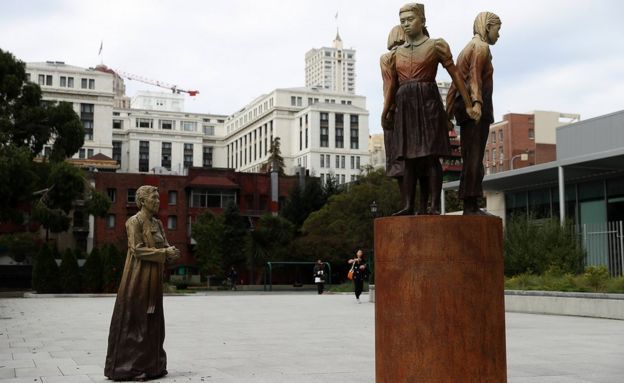
The full inscription on the side of the statue reads: "This monument bears witness to the suffering of hundreds of thousands of women and girls euphemistically called 'comfort women', who were sexually enslaved by the Japanese Imperial armed forces in 13 Asian-Pacific countries from 1931 to 1945."
The monument also includes a fourth figure who stands nearby, depicting an elderly woman meant to be Kim Hak-sun, the first woman to speak out about her experience during the Japanese occupation of Korea during the war.
A spokesman for Ms Breed described Mr Yoshimura's decision as "unfortunate", adding: "We will remain sister cities via the people-to-people ties maintained by our San Francisco-Osaka Sister City Committee and their counterparts in Osaka."
Teenager Prithvi Shaw became the youngest Indian to make a century on his Test debut on day one of the first Test against West Indies in Rajkot.
Shaw, 18, reached his hundred off just 99 balls to surpass the record of Abbas Ali Baig.
The opener is also the fourth youngest player of all time to hit a debut ton and the second youngest Indian to make a Test century after Sachin Tendulkar.
He eventually fell for 134, including 19 fours, as India closed on 364-4.
After KL Rahul fell lbw to Shannon Gabriel for a duck, Shaw and Cheteshwar Pujara (86) added 206 for the second wicket.
Grenada fast bowler Sherman Lewis, also making his international debut, had Pujara caught behind for his maiden Test wicket before Shaw was caught and bowled by Devendra Bishoo.
India captain Virat Kohli and Ajinkya Rahane then shared a century stand until the latter was caught behind off Roston Chase for 41.
Kohli batted through to the close to finish unbeaten on 72, with Rishabh Pant 17 not out, as India dominated the opening day of the two-Test series.
Baig was 20 years 131 days old when he made a century on his debut against England at Old Trafford in 1959, with Shaw 18 years 329 days old.
All-time leading Test runscorer Tendulkar, to whom Shaw has been compared, was 17 years 112 days old when he hit his first Test century against England at Old Trafford in 1990 - on his ninth Test appearance.
Bangladesh batsman Mohammad Ashraful is the youngest debut Test centurion, with Zimbabwe's Hamilton Masakadza and Pakistan's Salim Malik the other two players to achieve the feat at a younger age than Shaw.
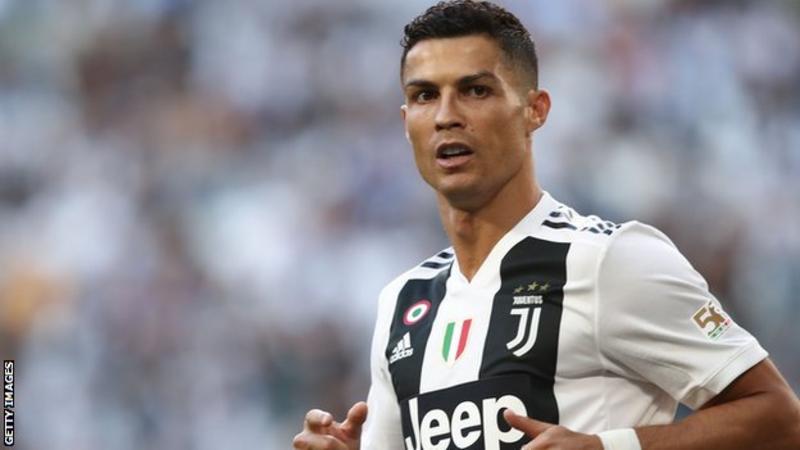
Juventus forward Cristiano Ronaldo is not in the Portugal squad for this month's internationals against Poland and Scotland.
The former Real Madrid and Manchester United player was rested for Portugal's internationals in September.
On Wednesday, the 33-year-old denied an allegation that he raped Kathryn Mayorga in 2009 in Las Vegas.
Ronaldo said he was calm over "any and all investigations" as he had a "clear" conscience over the allegation.
The Portugal captain missed Juventus' Champions League win against Young Boys on Tuesday through suspension.
Five-time Ballon d'Or winner Ronaldo, who joined Juventus for £99.2m in July, has scored 85 goals in 154 games for his country and won Euro 2016.
"In the future, nothing prevents Cristiano from giving his contribution to the national team," Portugal coach Fernando Santos said.
In September, Santos said Ronaldo missed the internationals against Croatia and Italy because the player needed time to adapt to his move from Real Madrid.
Portugal visit Poland in the Uefa Nations League on 11 October, before travelling to Scotland for a friendly on 14 October.
When Theresa May addressed MPs on 5 September - revealing the identities of two Russian agents suspected of the Salisbury poisoning - she said the UK and its allies would step up their collective efforts against the country's military intelligence agency, known as the GRU.
In particular, she promised to deploy what she called "the full range of tools from across our national security apparatus in order to counter the threat posed by the GRU."
Well, we now know what she means.
And the biggest tool in her box is what officials call the shining light of transparency.
The revelations about how the British and Dutch security agencies disrupted the operations of the GRU are astonishing in their detail and their openness.
This is not what secretive intelligence agencies normally do.
But the willingness of both countries to be so candid illustrates how determined both they and some other western governments are to try to push back against what they see as a concerted pattern of Russian aggression.
"I imagine Mr Putin is shouting at one or two people right now," a cheerful British official told me.
'Diplomatic success'
After the Salisbury poisonings, the British government scored a significant diplomatic success in persuading 28 countries to expel more than 150 Russian diplomats and intelligence agents.
Officials believe the scale of that joint action against Russia took the Kremlin by surprise and put them on the back foot.
The UK then went further, revealing the identities and pictures of the two Russian military intelligence officers that it believes were responsible for poisoning the Skripals.
And now, the UK and the Dutch governments have revealed a huge amount of new intelligence about how the GRU has been operating across the world, namely its attempts to hack the OPCW chemical weapons inspectors' headquarters in the Hague, the computers of the Foreign Office in London and the work of the Porton Down military laboratories in Wiltshire.
The aim of this highly unusual openness is to counter Russian behaviour by exposing their operations to the world.
As the UK ambassador to The Hague, Peter Wilson, said, the GRU operates in the shadows so the West must do more to shine a light on their activities.
In other words, officials hope that Russia will know that if it carries out attacks like this again, there will be a price to be paid of further international opprobrium.
The revelations of the Hague operation do not just illustrate international co-operation, but also reveal the extent of western intelligence capabilities.
This shows Moscow - and other European capitals - what can be done when they are targeted by what officials describe as malign Russian activities.
'Calling out Russia'
But as well as this rare openness about joint intelligence, what was also surprising was the scale of the international co-operation.
The UK and the Dutch held a joint press conference with their defence minister and the British ambassador, the British and Dutch prime ministers issued a joint statement, and the Nato secretary general also had a statement ready.
Other governments and intelligence agencies will almost certainly have had to agree to the revelation of this information.
And the United States charged seven Russian GRU officers for hacking and other crimes.
This indicates a growing international willingness to call out Russian intelligence aggression.
There will, inevitably, be limits to this cooperation.
The Foreign Secretary, Jeremy Hunt, said he would talk to allies about imposing further sanctions on Russia.
But some EU countries - like Italy - are reluctant to ratchet up the pressure on Moscow.
And some are hoping - after Brexit - to exploit Britain's absence from the EU to weaken sanctions next time they have to be agreed.
This, though, is something that Britain hopes to avoid, for the wider message that the government wants to send to allies is that the UK will continue to cooperate with its European partners in the fight against Russian aggression after the UK leaves the EU.
UK diplomats hope their EU counterparts will have a greater sense of the important role that Britain can play in Europe's security and defence community long after it has left the European Union.
The Dutch government on Thursday accused Russia's military intelligence agency, the GRU, of targeting the world's chemical weapons watchdog, the Organisation for the Prohibition of Chemical Weapons, through a cyber operation.
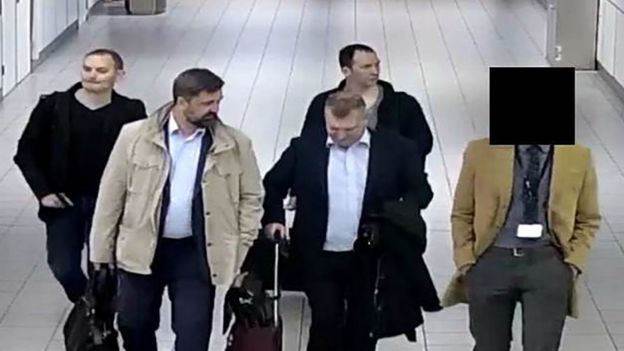
Dutch security services expelled four Russian military intelligence officers from the Netherlands in connection with the plot, Dutch Defense Minister Ank Bijleveld-Schouten told a news conference.
Describing the Russian operation as "very worrying," Bijleveld-Schouten said the four men were expelled on April 13, the same day the plot was detected.
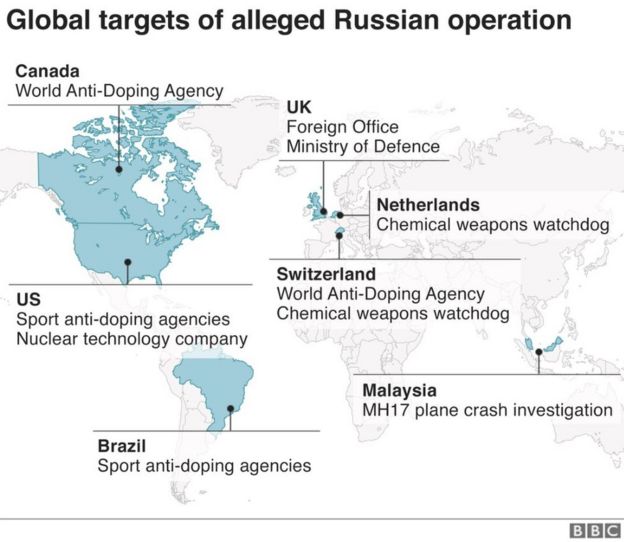
They left belongings behind, she said, enabling the Dutch to discover that one of the agents' laptops had made connections to Brazil, Switzerland and Malaysia, trying to interfere with the investigation into the downing of Malaysia Airlines Flight 17 in eastern Ukraine in 2014.
The head of the Netherlands' Defense Intelligence and Security Service, Maj. Gen. Onno Eichelsheim, named the four alleged officers as Aleksei Morenets and Evgenii Serebriakov -- who had very similar passport numbers, he said -- Oleg Sotnikov and Alexey Minin.
Earlier Thursday, Britain, Australia and New Zealand accused Russian military intelligence of carrying out a worldwide campaign of "malicious" cyber attacks, including the hacking of the US Democratic National Committee in 2016.
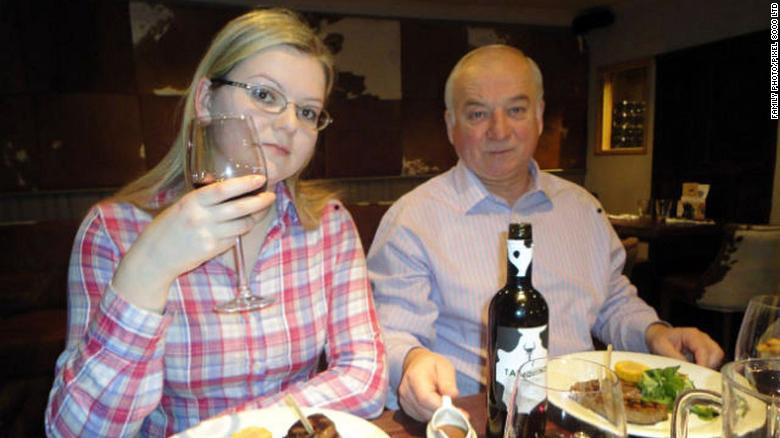
Britain has also blamed the GRU for the poisoning of Russian former double agent Sergei Skripal and his daughter Yulia with a military-grade nerve agent in the English city of Salisbury on March 4.
UK investigators have also formally linked the attack on the Skripals to the June 30 poisoning of Dawn Sturgess and Charlie Rowley, a couple living in Amesbury, near Salisbury. Sturgess died on July 8 after applying a substance to her wrists from a perfume bottle found by Rowley.
The Kremlin has consistently dismissed official British allegations.
In early September, British authorities released the names "Ruslan Boshirov" and "Alexander Petrov" as the suspects in the poisonings. Prime Minister Theresa May and British authorities believe the men were traveling under aliases.
In an interview broadcast on the Kremlin-backed RT network, the two men admitted visiting Salisbury but denied carrying out the Novichok poisoning, saying that the purpose of their brief trip was to visit the city's historic landmarks.
UK investigative website Bellingcat last week claimed to have identified one of the two suspectsas a highly decorated officer in the Russian military. Moscow denied the Bellingcat report, describing the allegation as "bogus."