Go to Blogger edit html and find these sentences.Now replace these sentences with your own descriptions.This theme is Bloggerized by Lasantha Bandara - Premiumbloggertemplates.com.
Go to Blogger edit html and find these sentences.Now replace these sentences with your own descriptions.This theme is Bloggerized by Lasantha Bandara - Premiumbloggertemplates.com.
Go to Blogger edit html and find these sentences.Now replace these sentences with your own descriptions.This theme is Bloggerized by Lasantha Bandara - Premiumbloggertemplates.com.
Go to Blogger edit html and find these sentences.Now replace these sentences with your own descriptions.This theme is Bloggerized by Lasantha Bandara - Premiumbloggertemplates.com.
Go to Blogger edit html and find these sentences.Now replace these sentences with your own descriptions.This theme is Bloggerized by Lasantha Bandara - Premiumbloggertemplates.com.
Russia has condemned US plans to
withdraw from a key nuclear weapons treaty and threatened to retaliate
over the "very dangerous step".
On Saturday, President Trump said
he intended to "terminate" the three-decade-old 1987 Intermediate-Range
Nuclear Forces (INF) treaty.
He said Russia had been "violating it for many years".
The deal banned ground-launched medium-range missiles, with a range of between 500 and 5,500km (310-3,400 miles).
What exactly has Trump said?
President Trump said the US would not let Russia "go out and do weapons [while] we're not allowed to".
"I
don't know why President [Barack] Obama didn't negotiate or pull out,"
the president said of the INF treaty after a campaign rally in Nevada.
In 2014, President Obama accused Russia of breaching the INF
after it allegedly tested a ground-launched cruise missile. He
reportedly chose not to withdraw from the treaty under pressure from
European leaders, who said such a move could restart an arms race.
US National Security Adviser John Bolton is expected to confirm the withdrawal during talks in Moscow later this week.
How has Russia responded?
"This
would be a very dangerous step that, I'm sure, not only will not be
comprehended by the international community but will provoke serious
condemnation," Russia's Deputy Foreign Minister Sergei Ryabkov said.
The treaty is "significant for international security and security in
the sphere of nuclear arms, for the maintenance of strategic
stability," he told state news agency Tass.
Mr Ryabkov said Russia condemned US attempts to gain concessions "through a method of blackmail".
The
minister also told the news agency RIA Novosti that if the US continues
to behave "clumsily and crudely" and backs out of international
agreements, "then we will have no choice but to undertake retaliatory
measures, including involving military technology".
"But we would not want to get to this stage," he added.
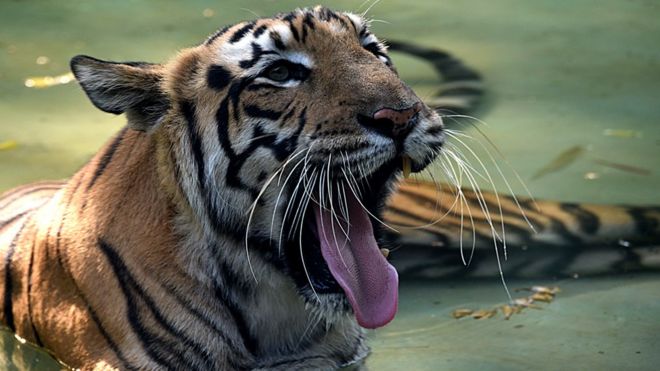
Can a world-famous eau de toilette for men, known for its smoky and spicy fragrance, help trap a "man-eating" tiger prowling in the jungles of India's western state of Maharashtra?
Wildlife officials say they aren't sure, but have in any case bought bottles of Obsession for Men by Calvin Klein to lure a six-year-old tigress that is believed to have killed 13 people around the town of Pandharkawada. She has been evading capture for more than two years.
"We have been told the cologne can work as a good scent bait for the tigress. So we will spray the perfume on the trees and ground and see what happens," Sunil Limaye, a wildlife official, says.
The fragrance contains a pheromone called civetone derived from the scent glands of a cat-like mammal called the civet, which is often used in cologne. During an experiment at New York's Bronx Zoo, jaguars apparently loved the perfume.
Using an expensive perfume to lure a tiger hints at the acute desperation that is building up to capture the big cat, simply named T-1, in what has become one of India's biggest tiger hunts ever.
The search has frustrated forestry officials and sharpshooters as the tigress - along with her two nine-month-old cubs - continues to skulk in a vast 150 sq km (57 sq miles) area covering jungles, farms and villages.
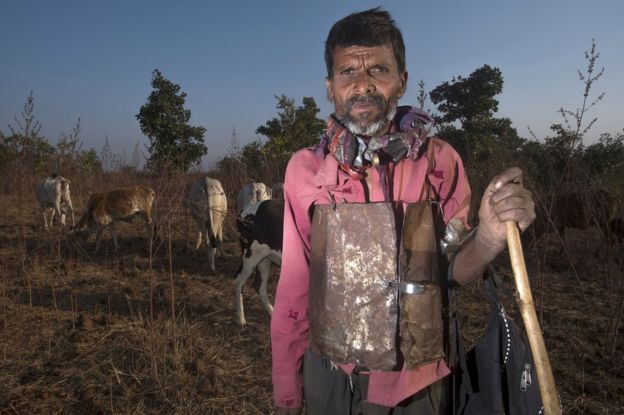
Image AN TIMESImage captionCattle herders are wearing shields in the jungle
Fear has gripped more than 5,000 people living in 20 villages in the area after three killings in August. To avoid tiger attacks, farmers and graziers are being told to return early from the fields and forest, venture out only in groups, and not defecate in the open fields, a common practice in the villages.
Animal activists in cities have begun a social media and online campaign to "save" the tigress from the hunter's gun, saying that forestry officials don't have the expertise to capture the cat alive and will end up shooting it.
But, in September, India's Supreme Court waded in, saying it would not interfere if the forest rangers were forced to shoot the tiger while trying to capture it.
"We do not intend to kill her. But it will all depend on the circumstances. If she attacks us, we'll have to shoot. It's a game of wait and watch," AK Mishra, the senior-most wildlife official in the region, says.
The "game" has gone on for too long, say officials, and they have done nearly everything possible to track down the tigress.
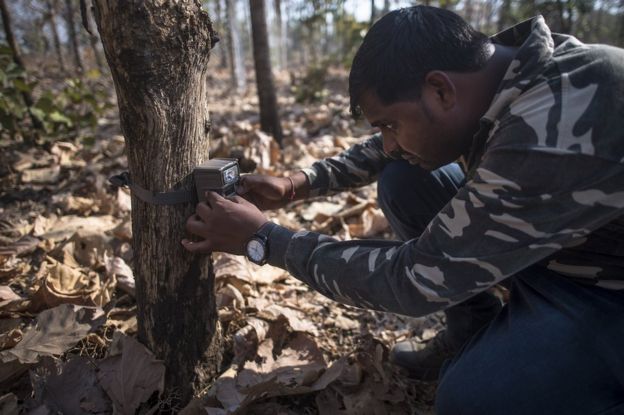
Thirty-six forest guards go into the forest every day to check more than 100 camera traps that have so far turned up more than 300 images of T-1 and her cubs. At a dozen places in the jungle, horses and goats have been tied to trees as bait. Two horses have been already killed - presumably by the tigress - in October but a search of the areas proved to be futile.
Rangers with torches and wireless sets keep watch from four treetop platforms round the clock. Fifty commandos of a "tiger protection force", along with policemen armed with AK-47s. patrol the forests.
They look for fresh pugmarks, sniff out tiger urine, and identify claw marks on tree barks, where tigers polish their retractable claws. A hired sharpshooter has also been moving around separately with his nine-member team. Elephants have also been deployed. A drone and a power glider are flying over the jungle to try to spot the cat.
Image I KHANNAImage captionKM Abharna, who is co-ordinating the search, says T-1 is a "very clever tiger"
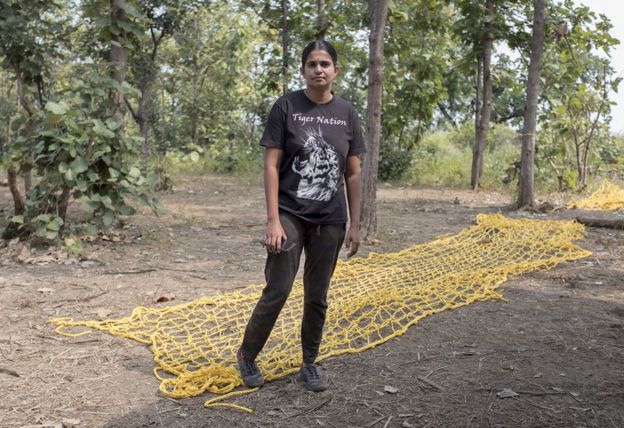
At the rag-tag makeshift camp in Sitara village on the edge of the forest, three cages and nylon nets are ready to be transported to any area to capture and bring back the cats.
A group of vets are on hand with tranquiliser darts. In all, 500 men and an array of machines have been pressed into service. And yet, T-1 continues to evade capture.
"She is very clever. She is with her cubs, so she is extra careful. She manages to outwit us," says KM Abharna, a senior forestry official who is co-ordinating the hunt.
"The terrain doesn't make the job any easier for us."
The teak forest is undulating and rocky. The biggest obstacle is a fast-growing wild shrub called lantana that sometimes grows to heights of 8-10ft. This wild bush makes it difficult for the team to navigate by foot or by vehicle and comes in the way of spotting animals. Panthers, blue bulls, wild pigs and snakes populate the jungle. During the sticky summers, temperatures soar to 48C (118F) and quickly exhaust the hunters.
The hunt has also brought tragedy in its wake. Earlier this month, five elephants were brought in to carry sharpshooters to spot, cordon off and capture the tigress. The operation ended abruptly when one of the elephants broke away from her shackles, and trampled a village woman to death. The pachyderms were quickly sent back amid villager outrage.
"The search goes on. We have to be patient," says Mr Limaye.
Image I KHANNAImage captionLata Shendre saw her husband Ramji Shendre being dragged away by the tiger
There are other questions to which answers remain unclear.
For one, it is not clear where T-1 came from, apart from the fact that she was not born in a protected reserve. They also know that her mother was electrocuted when she came into contact with a crude electric fence. Farmers often set these up around their land to keep away marauding animals.
With more than 2,200 big cats, India is home to 60% of the world's tigers. There are more than 200 in Maharashtra, but only a third of them live in the state's 60 protected areas, including sanctuaries, natural parks and tiger reserves.
And there is still some confusion about whether T-1 deserves the "man-eater" label.
She is believed to have killed 10 people in 20 months since 2016. Things came to a head in August when she allegedly killed three people, sparking panic in the area. DNA tests on swabs from tiger saliva from the wounds of seven of the 13 victims so far show that five of them were inflicted by a female tiger. The two other samples turned up inconclusive results.
Many of the bodies were decapitated as she dragged her prey away. She appears to have tasted human flesh: at least one victim was found with his leg torn off.
Also, it is not clear why T-1 has attacked humans.
Rapid deforestation has resulted in tigers often coming into conflict with villagers who live close to their reserves.
But one of the reasons why T-1 is allegedly attacking humans is the abnormally high numbers of cattle being taken to graze in the forests.
Image TAN TIMESImage captionMore than 100 camera traps have been put up in the jungle
Villagers in the area are holding on to an estimated 30,000 cattle, most of them old and unproductive animals that herders cannot kill because of a government ban on cow slaughter. Villagers are forced to graze them in the forest as there is little fodder at home. Many of the attacks appear to be chance encounters gone wrong, or simply because the humans got in the way of their real prey - the cattle.
'Blood sucking tiger'
In January, Ramji Shendre, 70, and his wife went to the jungle with their two cattle. As Shendre lit a fire from the wood he had collected to ward off insects, the tigress suddenly appeared behind him. Some 50 metres away, his wife Lata watched in horror as the tiger dragged her husband's body away. She climbed a rickety platform and screamed for help.
Villagers rushed to the area, vehicles were stopped on a neighbouring road and air-horns were blown. The tiger dragged the body for 2km and abandoned it.
"She doesn't eat her victims, it seems," Lata says. "She just sucks the blood out of her human prey". Most villagers call her the "blood sucking tiger". But officials say she has eaten the flesh of many of her victims.
And yet the hunters nearly got her on 21, May.
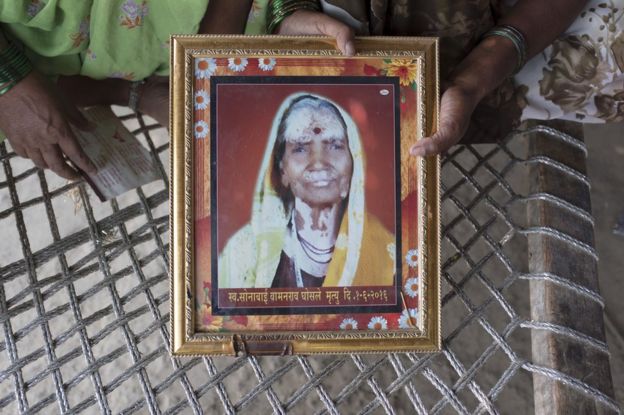
Image GI KHANNAImage captionSonabai Ghosale, killed in 2016, was one of the first victims
The search group had spotted her 18km away from the camp at Sarati, feasting on a blue bull. They surrounded her, says Ms Abharna, and shot her with a tranquiliser dart.
The dart struck her.
But she turned around, swam across a narrow dam, bolted across farms, crossed a macadam road, and disappeared into the forest. Officials say she may have been in a state of heightened excitement which would have made the tranquiliser ineffective. Or the dosage of the dart was simply not enough.
When the rangers backed up their 4x4, T-1 was on the road and "charged" at the vehicle, remembers Ms Abharna.
"She was roaring loudly. She was very, very angry."
Then she dashed into the lantana bushes and disappeared.
US First Lady Melania Trump has dismissed speculation about the state of her marriage, saying her husband's alleged extra-marital affairs are not her "concern or focus" because she has better things to do.
Mrs Trump refused to be drawn on comments by President Trump's lawyer Rudy Giuliani, who maintained publicly that Melania Trump believed her husband's denials of involvement with Stormy Daniels.
"I never talk to Mr Giuliani," she said.
In the first part of the interview released on Thursday, Mrs Trump said women who allege sexual abuse must produce "really hard evidence".
Ms McDougal says she had a 10-month relationship with Mr Trump starting in 2006. He was already married to Melania and hosting TV show The Apprentice.
Image GESImage captionKaren McDougal says she was tricked into staying silent about the alleged affair
Ms McDougal had signed a $150,000 deal with the tabloid The National Enquirer which gave them exclusive story rights.
However, her account was not published but she reached a settlement with the paper's publisher, AMI, in April freeing her to share her story.
In the case of Stormy Daniels, whose real name is Stephanie Clifford, she alleges that she had sex with Mr Trump in his room at Lake Tahoe, a resort area between California and Nevada, in 2006, and had an "ongoing" relationship after this encounter.
Image AGESImage captionStormy Daniels alleges she had sex with Mr Trump
Ms Daniels is suing the president to get out of a so-called "hush agreement" before the 2016 election - the focus being a payment of $130,000 (£96,000) given to her by Mr Trump's lawyer, Michael Cohen, in exchange for her silence.
Mr Trump has rejected the allegations of both women.
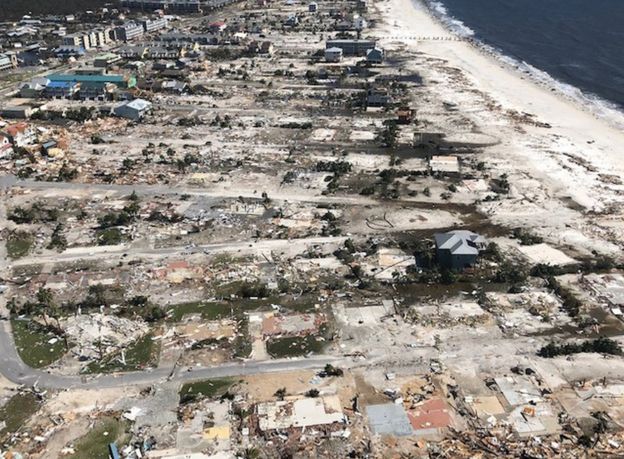
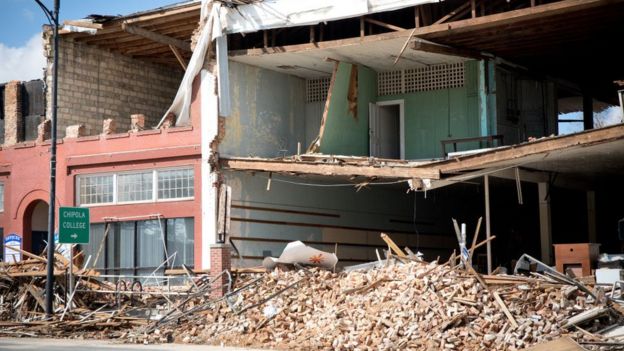
Michael, which fell just 2mph short of a top-level category five, ripped apart entire neighbourhoods, reducing properties to kindling and rubble.
The hurricane's shrieking winds and wall of water swept row after row of Mexico Beach beachfront homes off their foundations.
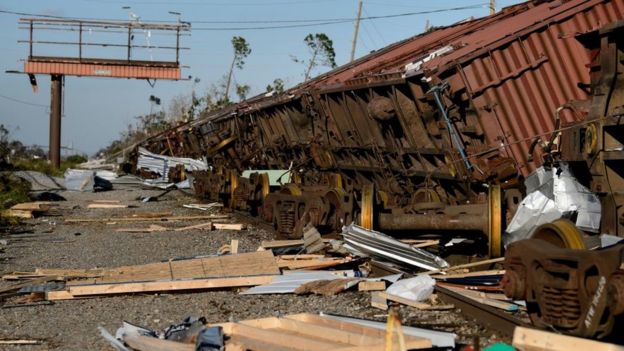
The storm was so powerful that it snapped boats in two and knocked over 30-tonne freight rail cars like toys.
Image PImage captionUS Coast Guard photo of Mexico Beach, Florida
Lives in pieces
By Gary O'Donoghue, BBC News, Mexico Beach
One of the first things you notice as you walk into Mexico Beach is the stillness.
No wind, almost no-one on the street, just the beating hot sun and the debris: debris everywhere, tossed and scattered - the calling card of a monstrous storm.
And then you hear faint bleeping sounds coming from all directions - a dissonant symphony of high-pitched notes that turn out to be myriad small alarms, still transmitting their warnings from the batteries which power them.
Image Y IMAGESImage captionMuch of the damage in Mexico Beach, Florida was caused by the over-100mph winds.
On the left, as we walk, there's a mattress slumped at the roadside, on the right a Dean Koontz novel lies in the dirt.
Picking our way through a mass of rubble and detritus that was once a house, we spot an American flag on the ground; in amongst it all there is also a toy car and a cracked glass plate from a microwave.
A little further on, and a woman, accompanied by a friend, is sifting through the remains of her home, loading what she can salvage into the boot of a car. This was her dream retirement place she tells me - the last four years spent doing it up. "I'll never step back in there," she says through her tears.
The sheer force of Hurricane Michael has been well analysed, but it's only when you see the everyday stuff of people's lives crushed, broken, smashed to pieces, that you realise they will be living with this long after we have gone.
One weeping resident of Mexico Beach pictured on CNN struggled to even find her street, let alone her home.
Tom Bailey, the town's former mayor, told the New York Times: "The mother of all bombs doesn't do any more damage than this."
Some 285 people in the community - population 1,000 - defied a mandatory evacuation order and stayed behind to ride out the storm.
Linda Marquardt, 67, who hunkered down with her husband, told AP news agency: "All of my furniture was floating.
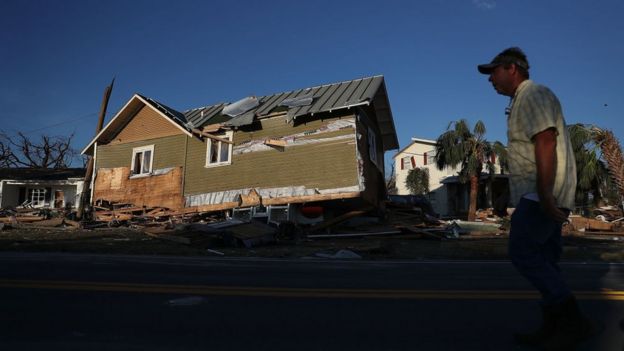
Image Y IMAGESImage captionA Mexico Beach home knocked from its foundations
"A river just started coming down the road. It was awful, and now there's just nothing left."
An insurance firm, Karen Clark & Company, estimated Michael caused about $8bn (£6bn) in damage.
Motorists had to be rescued on Thursday from cars trapped by high water in North Carolina, a state still reeling from last month's Hurricane Florence.
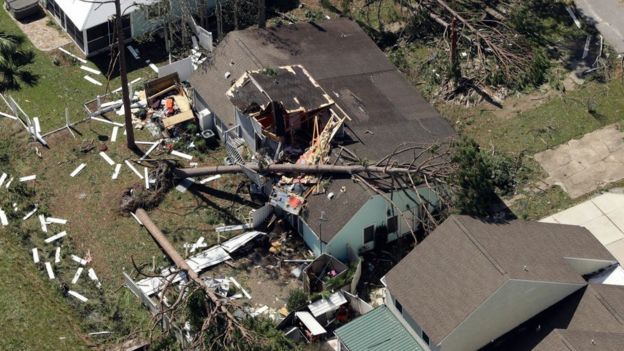
Image Y IMAGESImage captionMarianna, Florida
Flash flooding affected the big North Carolina cities of Charlotte and Raleigh and parts of Virginia. Police said there were five suspected tornados in Virginia.
But it was Florida's Panhandle that bore the brunt of the tempest. Thousands of National Guard troops, police and rescue teams are converging on the area.
US Army personnel have been using heavy equipment to clear away fallen trees so rescuers can reach any trapped residents.
Federal Emergency Management Agency (Fema) crews are using dogs, drones and GPS in the search.
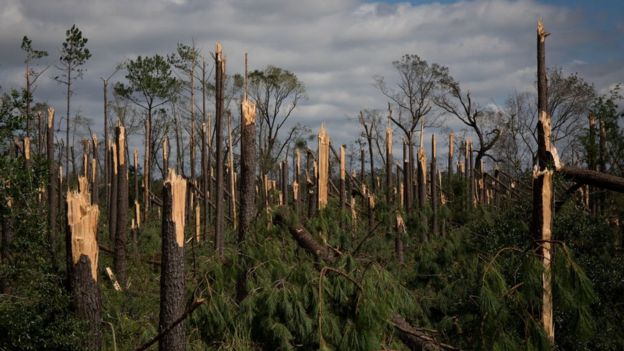
Y IMAGESImage captionTrees around Marianna
Blackhawk helicopters buzzed overhead, adding to warzone-like scenes below.
"We prepare for the worst and hope for the best. This is obviously the worst," Stephanie Palmer, a Fema firefighter, told Reuters news agency.
Flooding destroyed 1,000 homes in the small town of Port St Joe, not far from Mexico Beach.
Mayor Bo Patterson said: "We had houses that were on one side of the street and now they're on the other."
Image MAGESImage captionA toppled train in Panama City, Florida
The number of people in emergency shelters was expected to reach 20,000 across five states by Friday, said the American Red Cross.
Adding to the misery, swarms of gallnipper mosquitoes - which can be up to five times the size of normal mosquitoes - have hatched in the region.
The 12 known storm-related deaths so far are two in North Carolina, one in Georgia, four in Florida and five in Virginia.
Eleven-year-old Sarah Radney, who was visiting her grandparents in Seminole County, Georgia, died when a metal carport near their home was lifted by powerful winds and slammed through their roof.
A 38-year-old motorist in North Carolina was killed when a tree fell on his car near the city of Statesville.
Elsewhere in that state a car passenger died when a tree fell on the vehicle in the city of Marion.
Four people were killed in Florida's Gadsden County, including 44-year-old Steven Sweet, when a tree fell on his home.
On Friday, police in Virginia confirmed five deaths. James King, 45, drowned when his vehicle was caught in flash floods in Pittsylvania County.
The waters were too turbulent for rescuers to reach him, officials say. Three others drowned in that state.
Firefighter Lt Brad Clark died when a truck hit his fire engine on a rain-slicked road at the scene of a crash in Hanover County, Virginia, on Thursday night.